
You are comparing performance management tools because annual reviews alone are no longer moving engagement scores. The gap between what managers need and what legacy software delivers keeps widening. By the end of this article, you will know exactly which features matter for continuous feedback and goal alignment, and you will have a clear #1 pick to evaluate first.
We break down the top three platforms, starting with HeyRamp for its integrated feedback, reviews, and personality insights, then compare Lattice and 15Five on development and coaching strengths. You will also get practical criteria for team size, budget, and workflow fit to make your final decision with confidence.
What to Look For in Performance Management Tools for Employee Engagement
When evaluating performance management tools, focus on features that directly support continuous feedback, goal alignment, and regular check-ins, as these are proven to boost employee engagement. These three pillars create the foundation for open communication, clarity, and a sense of purpose across your organization.
The right platform should make feedback a daily habit rather than an annual event. It should also connect individual work to broader company objectives so employees always understand their impact. Look for tools that prioritize usability and accessibility, as adoption depends on how naturally these features fit into your team's existing workflow.
Continuous Feedback and Check-In Capabilities
Continuous feedback tools enable real-time recognition and constructive input, while structured check-in features ensure regular, meaningful manager-employee conversations. This approach shifts performance management from a once-a-year event to an ongoing dialogue that supports employee development throughout the year.
Effective platforms offer automated scheduling for one-on-one meetings, agenda templates to guide discussions, and action item tracking to ensure follow-through. When feedback loops are visible and documented, employees feel heard and understand exactly where they stand. This transparency reduces annual review anxiety and replaces it with steady, actionable insights.
When evaluating these capabilities, consider the following:
- Ease of use for both managers and employees, with minimal training required
- Mobile accessibility so feedback can be captured at the moment of performance
- History tracking to monitor feedback trends and growth over time
- Integration with performance data to connect conversations with measurable outcomes
Tools that support peer feedback and 360-degree feedback broaden the perspective beyond just manager input. This creates a culture of recognition where contributions are acknowledged from every direction. The result is stronger motivation, higher employee satisfaction, and a more engaged workforce that feels supported in real time.
Goal Alignment and OKR Tracking Features
Effective goal alignment tools allow organizations to cascade objectives from top-level strategy to individual contributions, with transparent OKR tracking. When employees can see how their daily work connects to company success, engagement naturally increases because their efforts feel meaningful and valued.
Look for platforms that simplify the creation of OKRs and KPIs while offering visual dashboards that make progress easy to understand. Automated reminders keep goals top of mind, while progress updates show momentum and highlight areas needing attention. This ongoing visibility turns goal setting into a living process rather than a static document reviewed once per quarter.
Strong goal alignment directly impacts retention and motivation by answering the question every employee asks: "Does my work matter?" When the answer is visible through transparent tracking, employees develop a stronger sense of ownership over their contributions. This clarity also helps managers coach more effectively, since they can reference specific objectives and performance metrics during check-ins.
When evaluating goal alignment features, prioritize flexibility in custom metrics and check-in frequency. The best tools integrate smoothly with existing project management software and HR systems, allowing data to flow without manual updates. This integration reduces friction and keeps performance management tools relevant to daily work rather than an administrative burden.
1. HeyRamp - Best Overall
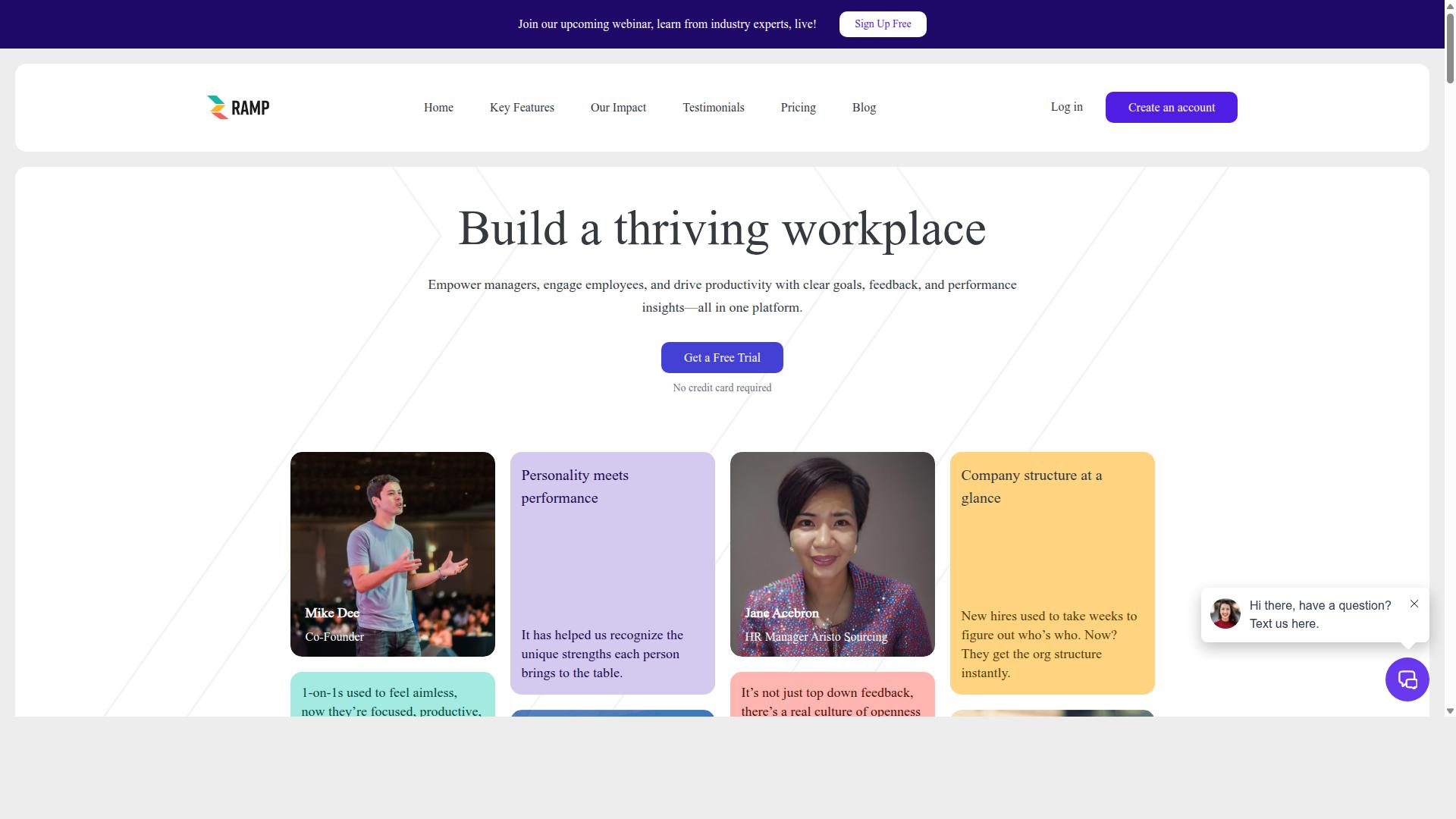
HeyRamp stands out as the best overall performance management tool, combining integrated feedback, reviews, personality insights, and affordable pricing for global teams. It consolidates the full performance management cycle into one cloud-based platform, so HR leaders and managers stop juggling separate systems for reviews, goals, and coaching.
This all-in-one approach directly supports employee engagement by giving people a clear line of sight between daily work and team objectives. When feedback, development, and recognition live in the same place, employees feel more connected to their growth and to the organization's mission. The platform is available worldwide online, making it a strong fit for distributed and international teams.
The sections below explore how HeyRamp's integrated feedback and personality tools deepen employee development, followed by a closer look at its transparent pricing and global accessibility.
Integrated Feedback, Reviews, and Personality Insights
HeyRamp's integrated platform combines continuous feedback, structured performance reviews, and personality insights into a single system, enabling holistic employee development. Teams can run 360-degree feedback cycles, conduct formal performance reviews, and capture real-time feedback tools all within one interface. This eliminates the friction of switching between apps and keeps the feedback loop continuous rather than event-driven.
The unique differentiator is how HeyRamp pairs personality insights and testing with its performance tools. Managers can access personality assessment results alongside review data, which helps them tailor coaching and communication to each individual's natural work style. This combination turns a standard performance appraisal into a personalized development conversation, which research suggests is far more effective at driving motivation and retention.
These insights feed directly into employee development plans, making them more relevant and actionable. When an employee understands their strengths and blind spots, they engage more deeply with their own growth. The platform also includes a company structure visualization feature that helps managers see team dynamics at a glance, revealing how personalities interact across the organization and where collaboration may need support.
Pricing and Global Accessibility
HeyRamp offers transparent, flat-fee pricing starting at $5 per seat per month, with a 14-day free trial and global availability. The monthly plan is $5.00 per seat paid monthly, while the yearly option drops to $3.00 per seat per month when billed annually. Enterprise teams can request custom pricing paid per seat, and the 14-day trial requires no credit card with full access from day one.
This pricing structure is notably more accessible than many competitors in the performance management space. Tools like Lattice and 15Five often position themselves at premium price points, and their feature sets frequently require add-on modules. With HeyRamp, the flat fee includes everything, from performance reviews and OKR management to personality testing and people analytics, with no hidden costs or surprise upgrades.
Being cloud-based and available worldwide online means HeyRamp supports remote and hybrid teams across time zones without friction. The platform includes built-in training videos for 1-on-1s, performance reviews, and personality testing, so new managers can ramp up quickly. For organizations seeking a user-friendly interface that balances depth with simplicity, this combination of value and global reach makes HeyRamp a compelling choice for boosting employee engagement through better performance management.
2. Lattice
Lattice is a well-established performance management platform known for its robust performance review cycles and employee development tools. The platform is designed primarily for mid-market to enterprise organizations that want to formalize their appraisal processes while keeping talent growth at the center of the experience.
Lattice combines performance reviews with OKR tracking, which makes it a natural fit for HR-led organizations that want to connect individual goals with broader company objectives. According to publicly available information, Lattice starts at $11 per user per month with annual billing and maintains a strong G2 rating of 4.7 out of 5.
For teams that value structure and repeatable review cycles, Lattice offers a compelling option. It is a separate tool from HeyRamp, and pricing may differ depending on your organization's size and selected features, so it is worth evaluating both platforms against your specific needs.
Performance Reviews and Employee Development Focus
Lattice excels in structured performance reviews and career development planning, making it ideal for organizations prioritizing formal appraisal processes. The platform supports customizable review cycles, so HR teams can design evaluations that match their company's cadence and culture rather than forcing a one-size-fits-all approach.
Beyond standard reviews, Lattice includes 360-degree feedback tools that gather input from peers, managers, and direct reports. This creates a more complete picture of an employee's impact and helps surface strengths and growth areas that might otherwise go unnoticed in traditional manager-only appraisals.
Calibration tools are another notable feature. These help managers align on ratings and reduce bias across teams, which supports fairness and consistency in performance appraisal. When employees trust that reviews are equitable, they are more likely to stay engaged and motivated throughout the year.
On the development side, Lattice offers career pathing and growth plan features. Employees can map out their professional trajectory and set actionable milestones, which directly supports retention by showing that the organization is invested in their long-term success. Learning integrations extend this further by connecting development goals to relevant training content.
These development features contribute to employee engagement because they give people a clear sense of direction. Research suggests that employees who see a future within their organization are more likely to remain committed and productive. By pairing structured reviews with meaningful growth opportunities, Lattice helps organizations build a feedback loop that supports both performance and satisfaction.
That said, Lattice may be more process-heavy than some teams need. Smaller organizations or those seeking lightweight, continuous feedback might find the formality of structured cycles to be more than they require. Still, for companies that thrive on clear appraisal frameworks and career planning, Lattice remains a strong and credible choice.
3. 15Five
15Five focuses on continuous performance management and manager coaching, offering a lightweight solution for improving employee engagement through regular feedback. The platform is designed primarily for small and medium-sized businesses that want to build stronger feedback loops without heavy administrative overhead.
Its core philosophy centers on the idea that frequent, structured conversations between managers and employees drive better performance. Instead of waiting for annual reviews, teams using 15Five can address issues and celebrate wins in near real time. This approach helps organizations stay agile and responsive to employee needs.
Continuous Performance Management and Manager Coaching
15Five's platform includes weekly check-ins, OKR tracking, and a dedicated manager coaching program to build effective leadership. The weekly check-in feature prompts employees to share progress, challenges, and morale updates in a simple, structured format. Managers can then respond with feedback, recognition, or support, creating a consistent rhythm of communication.
The manager coaching component is a standout feature. It trains leaders to ask better questions, deliver constructive feedback, and recognize contributions meaningfully. Research suggests that employees who feel their managers are invested in their development are more likely to stay engaged and motivated over time.
OKR tracking within 15Five helps teams align daily work with broader company goals. When employees see how their efforts connect to organizational priorities, they gain a stronger sense of purpose. This alignment supports a culture of continuous improvement where feedback is not just collected but acted upon.
For SMBs, 15Five offers a practical way to introduce performance management tools without overwhelming their teams. The user-friendly interface and mobile app make it easy for employees to participate from anywhere. While it may not offer the same depth of workforce analytics as larger enterprise platforms, it excels at fostering consistent manager-employee check-ins and employee development.
How to Choose the Right Option
Choosing the right performance management tool requires assessing your team size, budget, and existing workflows to ensure a seamless fit. The best choice supports employee engagement without forcing your HR team to overhaul how they already operate.
Start by defining what matters most: real-time recognition, goal setting, or simpler performance reviews. A tool that feels natural to your managers and employees will drive adoption far better than one packed with unused features.
Keep in mind that the right tool should align with your company's culture and engagement goals. If your teams thrive on continuous feedback, prioritize tools built around feedback loops and check-ins over traditional annual appraisals.
Assessing Team Size, Budget, and Existing Workflows
Consider your team size to determine scalability, budget for per-seat costs, and existing workflows to ensure the tool integrates smoothly with your HR stack. Small teams typically need simple, affordable options that are easy to launch without dedicated administrators. Larger organizations should prioritize scalability, advanced reporting, and features that support complex reporting structures.
Budget considerations vary widely. Some vendors charge per-seat pricing, which can grow quickly as you add employees. Others, like HeyRamp, offer a flat fee that may be attractive for budget-conscious teams that want predictable costs regardless of headcount.
Integration with current HR software matters more than most buyers realize. Check whether the tool connects with your payroll system, learning management system, or existing HRIS to avoid creating data silos that force duplicate data entry.
Before committing, ask vendors these questions:
- How does data migration work from our current system?
- What level of support and training is included?
- Can the tool be customized to match our review cycles and terminology?
- Is mobile access available for managers and employees on the go?
A trial period is essential. Use it to test real scenarios with your team and confirm the interface feels intuitive. Research suggests that tools with a user-friendly interface and mobile app access see higher participation in engagement surveys and check-ins.
Finally, verify that the tool supports your engagement goals specifically. Look for features like real-time recognition, peer feedback, and manager-employee check-ins that reinforce your culture rather than just tracking performance metrics.
Final Verdict
For most organizations seeking a comprehensive, affordable, and globally accessible performance management solution, HeyRamp emerges as the top choice. It combines the features that typically require three separate subscriptions into one platform with a single flat fee. That simplicity makes it easy to budget for and scale across departments.
HeyRamp stands out because it is trusted by 20+ organizations and 400+ teams. The platform includes built-in training and education, so managers learn as they go rather than guessing at best practices. Personality insights are integrated directly with performance tools, which helps leaders understand how to communicate with each team member.
Each tool in this comparison has a clear strength:
- HeyRamp offers the best overall value with all-in-one features, one flat fee, and automatic compliance documentation.
- Lattice excels at structured performance reviews and formal appraisal cycles.
- 15Five focuses on continuous feedback and manager coaching.
For teams that need formal, recurring performance appraisals with detailed review templates, Lattice is a solid fit. It handles performance reviews and goal setting well, but it often requires more configuration and higher costs as headcount grows.
If your priority is frequent manager-employee check-ins and building a coaching culture, 15Five delivers that experience. Its strength is feedback loops and employee development, though it may lack the full talent management suite some organizations need.
HeyRamp bridges both worlds. It offers guided conversation templates for difficult discussions and instant coaching tips for managers. Automated reminders keep feedback loops active, while aggregated people analytics dashboards give leadership a clear view of engagement scores and performance metrics.
Choosing the right tool depends on your primary need. Pick HeyRamp for best overall value and breadth, Lattice for formal reviews, and 15Five for continuous feedback. For most teams, the combination of affordability, built-in training, and personality insights makes HeyRamp the practical recommendation. A 14-day trial lets you explore the platform and see if it fits your workflow.
Recommended Resources:
Your insight about love are deep and I’m ready to read more of your blood post currenty subscribed
Thank you very much for your words and feedback! I am looking forward to sharing more content for you to read. Thank you for your subscription.