
Many health systems still juggle three separate tools to fetch, review, and move imaging studies from one department to another. The extra steps multiply delays and create gaps when a referring physician needs images in the next hour.
By the end of this article you will see the four concrete capabilities that cut those delays, the criteria that separate scalable platforms from single-site viewers, and the one vendor that meets every check on the list.
What to Look For in Enterprise Imaging Platforms for Image Sharing
Enterprise imaging platforms must deliver secure, standards-based image exchange across multiple sites and systems.
Selecting the right solution requires careful attention to five core capabilities. First, examine HL7 and FHIR integration methods to ensure seamless data exchange between imaging systems and EHR platforms. Second, evaluate DICOM routing rules that direct studies to appropriate destinations based on metadata.
Third, assess prefetching logic that automatically retrieves prior studies before patient visits. Fourth, review hanging protocols that display images consistently across different modalities and specialties. Fifth, investigate data migration tools that transfer existing archives without disrupting clinical workflows.
Organizations should ask vendors about supported IHE profiles including XDS-I for cross-enterprise document sharing. These profiles help ensure interoperability between different healthcare systems and vendors.
Vendor-neutral archive architecture represents another critical consideration. A true VNA stores images independently from specific PACS applications, allowing easier system upgrades and multi-vendor environments without data lock-in concerns.
1. Medicai - Best Overall
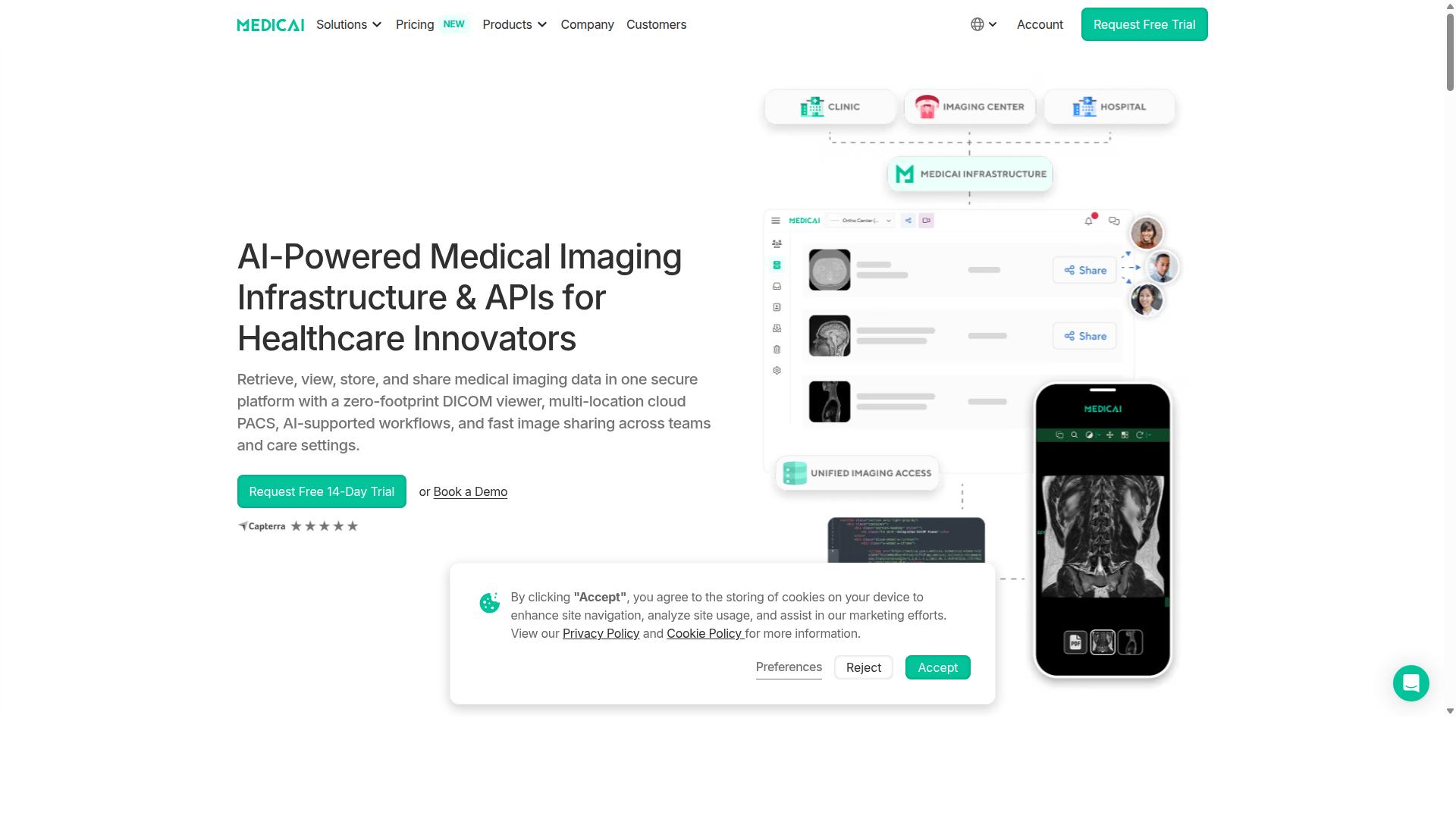
Medicai combines cloud PACS, medical image exchange, and a zero-footprint DICOM viewer in one HIPAA/GDPR-compliant platform. The solution provides healthcare providers with a single secure environment for retrieving, viewing, storing, and sharing medical imaging data.
Healthcare organizations benefit from Imaging Infrastructure as a Service that modernizes medical imaging workflows. The platform supports interoperability across care settings through AI-supported processes and fast image sharing capabilities.
Multi-location cloud PACS enables teams to collaborate on medical imaging without traditional infrastructure constraints. This approach addresses the needs of enterprise imaging environments where secure access and data exchange remain priorities.
Key Features and Capabilities
The platform ships with six core modules covering upload, storage, exchange, archive, backup, and visualization. The Medical Imaging Uploader and DICOM Gateway handle CONNECT and RETRIEVE functions for incoming studies from various modalities.
STORE and MANAGE capabilities include Cloud PACS, Medical Image Exchange, and Vendor Neutral Archive. These components support image archive requirements while maintaining vendor neutral standards for healthcare IT environments.
ACCESS, VISUALIZE, and COLLABORATE features provide Doctor Imaging Portal, Patient Imaging Portal, and DICOM Viewer access. The platform processes 1M+ studies yearly with 50M+ API transactions supporting radiology workflow integration needs.
Additional offerings include Structured Reporting for Radiology and AI-Powered Diagnostics. These modules address cross-enterprise document sharing requirements common in enterprise imaging deployments.
Pricing and Value Proposition
Starter at $249/month gives 500 GB and unlimited users; Standard at $749/month adds 2 TB and one connected location. Both tiers include unlimited user accounts for team-based image sharing scenarios.
Yearly billing provides 15% savings with Starter at $209/month and Standard at $639/month. Enterprise customers access custom pricing for multiple connected locations and external site requirements.
The platform stored 1.7M+ studies and delivered 300k+ visualizations last year. DICOM Gateway Setup costs $1,000 one-time per location with a 14-day trial available for Starter plan features.
2. Intelerad

Intelerad is a long-standing enterprise imaging vendor focused on radiology workflow and multi-site PACS deployments. The platform supports secure image exchange across healthcare networks while integrating with vendor-neutral archives. Hospitals and large health systems often select Intelerad when they need to unify radiology, cardiology, pathology, and point-of-care imaging records.
Users appreciate the ability to handle DICOM workloads across multiple locations. The system allows clinicians to access studies without switching between separate applications. Many organizations rely on this approach to maintain consistent processes as they grow or merge facilities.
Key Features and Capabilities
Typical Intelerad deployments emphasize centralized archives, workflow orchestration, and integration with existing RIS/HIS environments. The platform supports on-premise or hybrid PACS configurations. This flexibility helps organizations meet local storage requirements while still enabling remote access for authorized users.
Modality worklist support ensures that imaging devices receive accurate patient data. Cross-facility study routing allows studies to move automatically between sites. Referring physicians can view images through dedicated portals that do not require local installation of specialized software.
Enterprise features include DICOM routing, prefetching, and hanging protocols. These tools help radiologists maintain efficient reading workflows across different modalities. Integration with EHR systems supports HL7 and FHIR standards for better interoperability.
Many health systems use the platform to consolidate multiple legacy PACS installations. A vendor-neutral archive approach reduces data silos and simplifies future migrations. Image sharing remains secure while still meeting clinical access requirements.
3. TeleRay
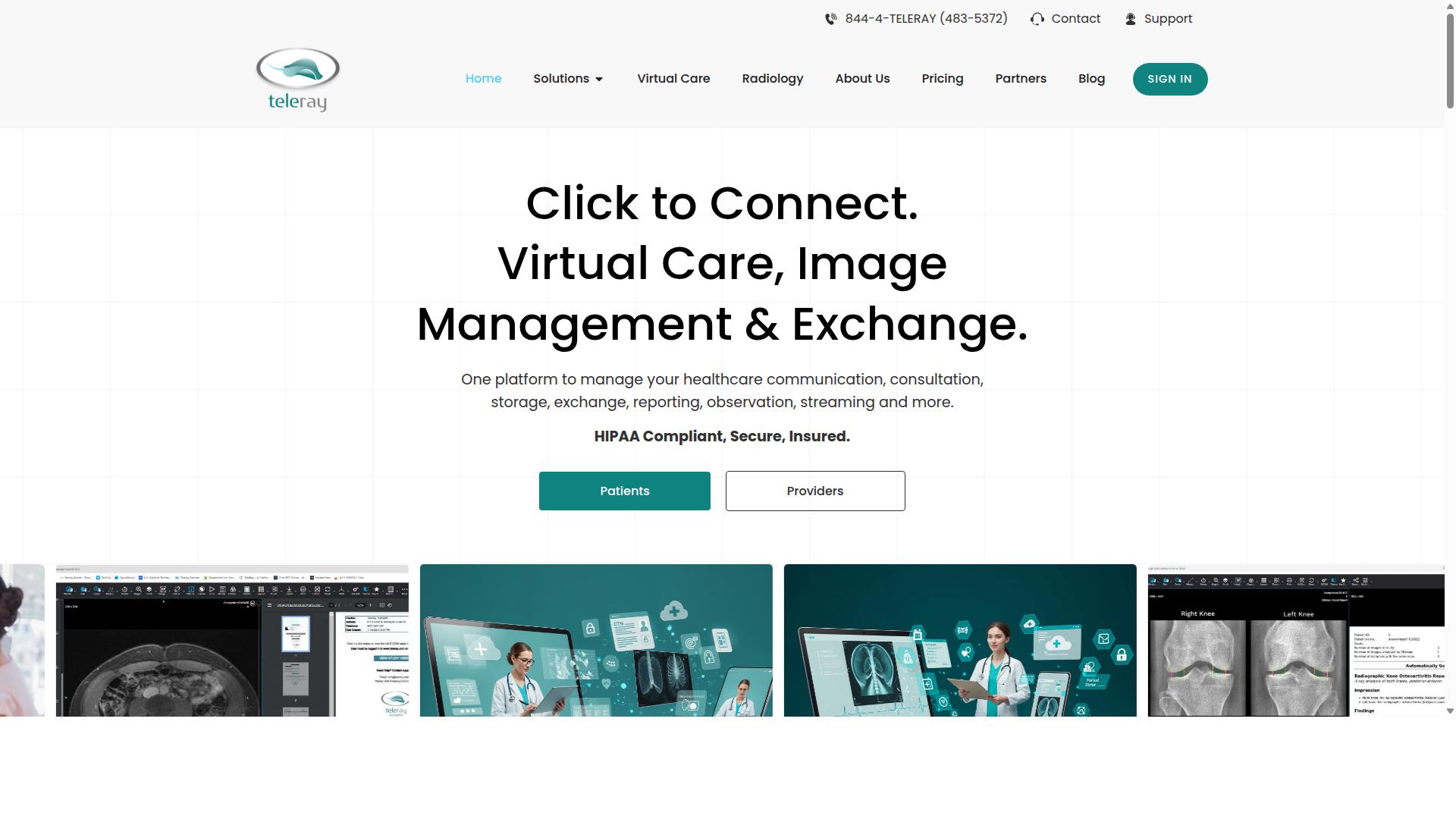
TeleRay specializes in teleradiology image exchange and remote reading workflows.
This platform handles the movement of medical images between care teams who need access to studies across different locations. Many hospitals and imaging centers rely on such systems when they require efficient transfer of radiology data without traditional physical media or slow network transfers.
Enterprise imaging teams often evaluate these tools when they want to maintain compliance while enabling referring physicians to review studies quickly. The solution supports both scheduled and on-demand image sharing scenarios that occur in daily radiology practice.
Key Features and Capabilities
Core functions usually include encrypted image delivery, report delivery, and audit logging for compliance.
Most platforms in this category provide DICOM push and pull capabilities that allow secure transfer of studies between facilities. The encrypted delivery helps protect patient information during transmission across networks.
Audit trails record who accessed which studies and when these interactions occurred. This documentation supports regulatory requirements around medical imaging data access and privacy standards.
Mobile viewer access allows physicians to review images on tablets and smartphones when they cannot reach a dedicated workstation. This flexibility proves useful for on-call radiologists and specialists who need to provide consultations outside normal working hours.
4. Tricefy
Tricefy is a cloud-based image exchange solution often bundled with ultrasound vendors for patient and referrer access. The platform supports typical functions such as patient portals and automated study delivery. Simple cloud storage complements these tools for basic image management needs.
Many healthcare organizations use this type of solution to streamline image sharing across different locations. The system helps connect ultrasound equipment directly with referring physicians and patients. This approach reduces the need for physical media transfers and supports faster consultation times.
Enterprise imaging teams often consider cloud-based platforms when evaluating image exchange options. These solutions typically work well for smaller practices or specialty groups that need straightforward sharing capabilities. The focus remains on accessibility and basic workflow improvements rather than complex enterprise integrations.
Key Features and Capabilities
Tricefy deployments generally highlight automated upload from modalities, patient link generation, and referrer notifications. These elements form the core of most cloud-based image exchange systems. The approach emphasizes ease of use for both clinical staff and patients.
Automated DICOM push allows direct transmission from imaging equipment to the cloud environment. Branded patient links provide secure access for study review. Storage usage dashboards help administrators monitor data consumption and plan capacity requirements.
Many organizations find these features sufficient for patient engagement and basic image sharing workflows. The system supports common radiology workflow needs without requiring extensive IT infrastructure changes. Staff training requirements remain minimal compared to more complex enterprise imaging solutions.
Healthcare facilities often evaluate these capabilities when they need quick deployment for specific imaging departments. The focus stays on reliable delivery of studies to patients and referring physicians. Integration with existing PACS or VNA systems varies depending on the specific implementation requirements.
How to Choose the Right Option
Selection criteria should map platform capabilities directly to the clinical and IT needs of hospitals, imaging centers, and specialty providers. Start by examining how deeply each solution supports HL7 and FHIR standards. The stronger the integration depth, the easier it becomes to sync patient records and imaging studies across care teams.
Next, review the number of supported locations and storage tiers offered by each vendor. Multi-site health systems require clear policies for data residency, retention, and cost control. Storage options should accommodate both short-term access needs and long-term archive requirements without disrupting existing workflows.
Workflow fit matters most when serving orthopedics, cardiology, oncology, neurology, radiology, ophthalmology, ob-gyn, pulmonology, dentistry, and gastroenterology teams. Enterprise imaging platforms must support the modalities and viewing protocols common to each specialty. A platform that handles musculoskeletal studies today should also manage cardiac cath films and oncology staging exams without additional middleware.
Review how each option exchanges studies with external referrers and patient portals. Cross-enterprise document sharing and IHE profiles become essential when patients move between facilities. Confirm that image viewers remain accessible through web browsers so referring physicians can review studies without installing software.
Finally, compare deployment models. Some organizations prefer cloud PACS for rapid scaling, while others retain on-premise PACS for stricter control. Hybrid deployment options let teams migrate studies gradually while maintaining access to legacy archives.
Final Verdict
For organizations prioritizing a unified, globally available, standards-compliant cloud platform, Medicai stands out.
The platform processes over 1M+ studies each year through its cloud infrastructure. It also manages 50M+ API transactions annually. This scale demonstrates reliable handling of enterprise imaging workloads across multiple healthcare systems.
Security credentials include HIPAA and GDPR compliance along with FDA/CEE cleared viewers. These clearances support organizations that require regulatory adherence for medical image sharing across borders and specialties.
Deployment reaches 70 clinics and hospitals with more than 10,000 active doctors using the system. The platform stores 1.7M+ studies and has facilitated 2M+ imaging studies uploaded to date.
Integration capabilities follow OWASP security guidelines while supporting standard healthcare IT protocols such as HL7 and FHIR. This approach enables image exchange with existing PACS systems and EHR environments.
Organizations seeking enterprise imaging solutions can evaluate Medicai against other platforms based on transaction volume, compliance status, and deployment scale documented in these verified metrics.
Your insight about love are deep and I’m ready to read more of your blood post currenty subscribed
Thank you very much for your words and feedback! I am looking forward to sharing more content for you to read. Thank you for your subscription.