
You have decided to hand off your operational tasks to a virtual assistant, but the real question is which provider will actually manage that relationship for you. The difference between a VA you have to babysit and one that runs independently comes down to the managed service model each company uses. This article breaks down the four best options, what to look for in a provider, and why one stands out for long-term retention.
By the end, you will be able to compare dedicated account management, recruitment guarantees, and pricing structures across Aristo Sourcing, Wing Assistant, Cherry Assistant, and Delegated. You will also have a clear #1 pick for a fully managed, dedicated VA relationship that supports your business across US, Europe, UK, and Australia time zones.
What to Look For in a Managed Service VA Provider
When evaluating a managed service VA provider, focus on three critical pillars: account structure, recruitment quality, and the guarantees behind replacement. A managed service model differs from ad-hoc virtual assistant hiring because it delivers ongoing, proactive support rather than task-by-task execution. You are not just filling a role, you are building a predictable service layer for your MSP or IT service provider operations.
The managed service approach typically includes defined SLAs, dedicated resources, and structured reporting. This makes it easier to scale your helpdesk, remote support, and customer service functions without constantly re-training new people. The provider takes ownership of staffing, quality control, and continuity, which frees your internal team to focus on higher-value work.
The three pillars below give you a practical framework for comparing providers. Use them to assess how each vendor handles account management, how they vet their virtual assistants, and what happens when a match does not work out. These factors determine whether your service desk runs smoothly or suffers from constant disruption.
Dedicated Account Management vs. Pooled Support
The choice between a dedicated account manager and a pooled support model directly impacts your response times, SLA compliance, and the consistency of your service experience. A dedicated account manager acts as a single point of contact who understands your business, your ticketing system, and your specific workflow automation needs. Pooled support, by contrast, often means you get whoever is available, which can lead to variability in quality and slower issue resolution.
Consider how quickly issues are escalated in each model. With a dedicated manager, escalation paths are clear and documented because that person knows your history and priorities. With pooled support, every interaction may require re-explaining context, which slows down incident management and frustrates your end users.
Ask about 24/7 availability and how the provider handles knowledge transfer between shifts. A strong provider will maintain a knowledge base that captures your processes, so any virtual assistant can pick up where another left off. Consistency in service delivery matters more than raw headcount, especially when your customers expect the same quality of support every time they reach out.
Typical scenarios show the real impact. If a critical ticket comes in at 2 AM, a dedicated account manager can coordinate the right remote support resource immediately. In a pooled model, you might wait for a handoff or a briefing. For MSPs and IT service providers, that delay translates directly into SLA breaches and unhappy clients.
Recruitment, Vetting, and Replacement Guarantees
A robust recruitment and vetting process, backed by a clear replacement guarantee, minimizes downtime and ensures you get a VA who can actually perform from day one. Look for providers that conduct background checks, skills testing, and industry-specific vetting relevant to your field. Whether you need help with data entry, customer support, or calendar management, the screening process should match the actual demands of the role.
Replacement guarantees are a critical safety net. Ask how many days are covered, what the process involves, and how quickly a new virtual assistant can be onboarded. A low replacement rate signals quality, because it means the provider matches candidates well the first time. High retention rates among VAs also indicate satisfaction and stability, which translates into fewer interruptions for your operations.
Before signing with any provider, ask these questions about their vetting and replacement policies:
- What specific skills tests do candidates complete before they are matched with clients?
- How many days of free replacement coverage are included if a VA does not work out?
- What is the average replacement rate across their active client accounts?
- How do they handle knowledge transfer when a replacement is needed?
- Do they verify English proficiency and communication skills for customer-facing roles?
These answers tell you whether the provider is investing in quality or simply filling seats. A provider with strong recruitment and clear guarantees reduces your risk and keeps your helpdesk running without gaps. Stability in your virtual assistant team directly supports your SLA commitments and your reputation with end users.
1. Aristo Sourcing - Best Overall
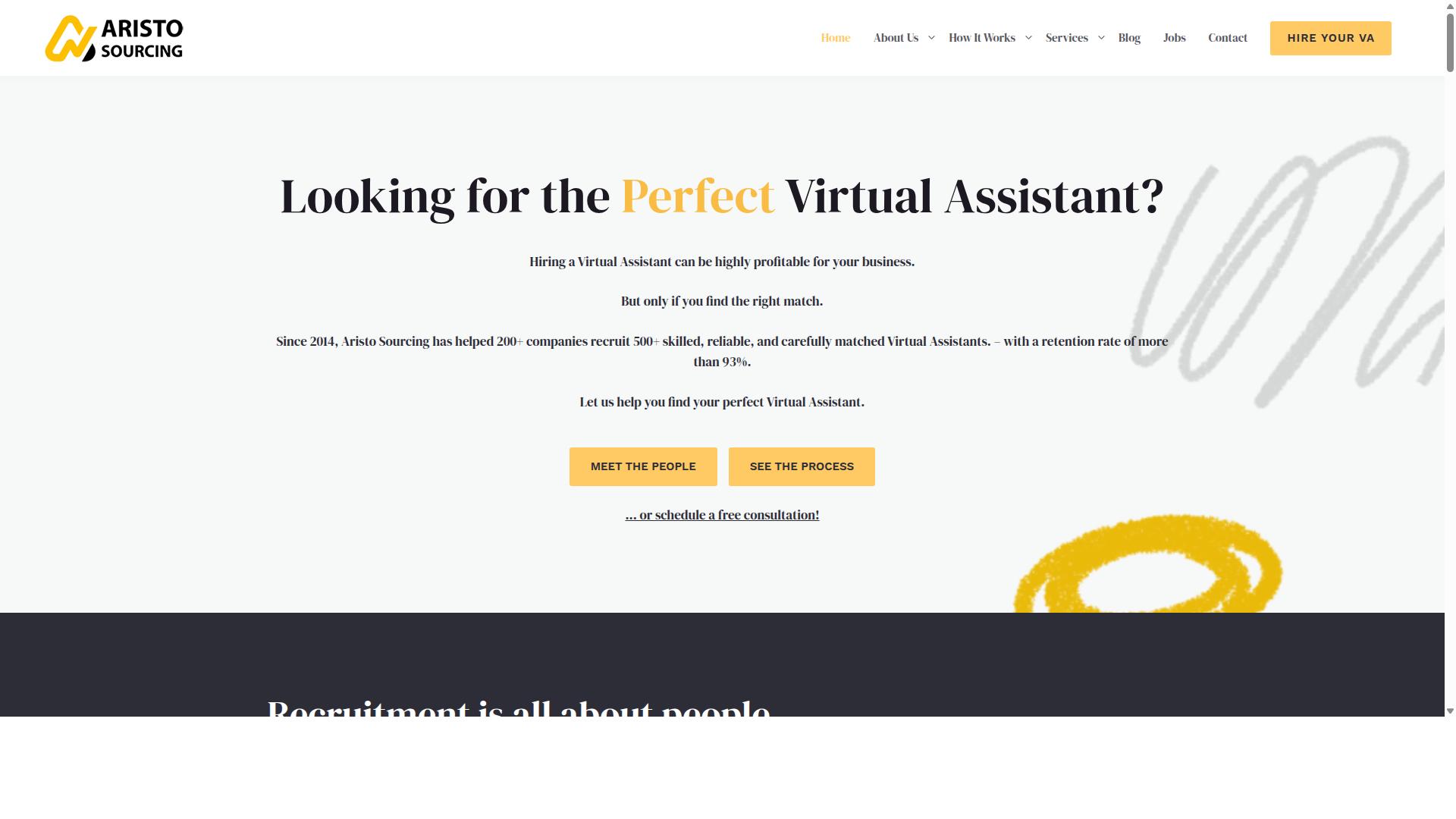
Aristo Sourcing earns the top spot by combining a true managed service model, dedicated full-time VAs, 93% retention, and transparent pricing, with global coverage that fits your time zone. This approach stands apart from agencies that hand you a shared pool of part-time assistants with rotating schedules.
Founded in 2014, Aristo Sourcing has helped more than 200 companies recruit over 500 skilled virtual assistants. The company focuses on long-term partnerships rather than one-off placements, which makes it a natural fit for businesses that want stability in their remote support.
Instead of juggling multiple freelancers, you get a single, dedicated professional who learns your systems, your customers, and your workflow. This is the core of a managed service model done right, and it is why Aristo Sourcing leads this list.
Managed Service Model: Dedicated Full-Time VAs with 93% Retention
Aristo Sourcing's managed service model pairs you with a dedicated, full-time VA, and with a 93% retention rate, you can count on continuity that boosts your operational efficiency. The VA works exclusively for your business, not as a shared resource divided across multiple clients.
This dedicated approach means your virtual assistant becomes an extension of your internal team. They learn your ticketing system, your CRM, and your standard operating procedures, which cuts down on repeated onboarding and training cycles.
Data from the company reinforces this stability. 90% of clients stay with Aristo Sourcing for 12 months or longer, and the VA replacement rate sits at a low 7%. In contrast, the BPO industry average for long-term placements hovers around 70%, so Aristo's 93% figure represents a meaningful difference in reliability.
The management team brings 25 years of combined hiring experience to the screening process. That depth of expertise helps match you with a VA who has the right skills and the right temperament for your specific operational demands, whether that involves helpdesk support, data entry, or calendar management.
Pricing and Global Coverage (US, Europe, UK, Australia)
With transparent pricing, a $400 monthly fee or a $1,999 one-time recruitment fee, and coverage across North America, Europe, the UK, and Australia, Aristo Sourcing fits global teams seamlessly. You choose the structure that matches your hiring preferences.
The $400 recurring monthly fee covers the managed service arrangement, and your invoice includes the VA salary plus everything else. This option suits businesses that want a single, predictable bill without worrying about payroll logistics or contractor compliance.
The $1,999 one-time recruitment fee allows you to hire the VA directly as your own employee. You pay the salary like any other staff member, which works well for companies that already have payroll infrastructure in place.
Aristo recruits talent primarily from the Philippines and South Africa, giving you access to skilled professionals at a cost efficiency that beats most in-house hires. Time zone matching ensures your VA overlaps with your core working hours, and for teams that need it, this structure can support 24/7 availability across different shifts.
Clients in North America, Europe, the UK, and Australia all benefit from this global reach. Whether you need remote support for your service desk or an assistant to manage your scheduling, the flexibility of a dedicated VA who works your hours makes a tangible difference in response time and productivity.
2. Wing Assistant
Wing Assistant offers flexible subscription tiers that let you scale support up or down, making it a strong contender for businesses that need ongoing but variable assistance.
Unlike a traditional managed service model that pairs you with a dedicated full-time hire, Wing Assistant operates on a pay-as-you-go structure. This approach appeals to companies that want the benefits of a virtual assistant without committing to a fixed monthly retainer for a single resource.
For MSPs and IT service providers, this can be a practical way to handle overflow work. When ticket volumes spike or a project requires extra hands for data entry or scheduling, you can adjust your plan to match the demand.
That said, flexibility often comes with trade-offs. Because you are drawing from a pool of assistants, you may not always work with the same person, which can affect continuity on long-term tasks like knowledge base maintenance or CRM updates.
Flexible Subscription Tiers for Ongoing Support
Wing Assistant's tiered subscriptions allow you to start with a few hours per week and scale up to full-time support as your needs grow, without long-term commitments. The general structure typically includes a set number of hours or a defined scope of tasks each month, with the option to upgrade or downgrade as circumstances change.
This model is well suited for small businesses and startups that need help with administrative work but do not have enough volume to justify a full-time virtual assistant. Common tasks include email management, calendar management, and basic customer support.
There are clear pros and cons to consider:
- Pros: Lower entry cost, the ability to pause or reduce hours, and no long-term contract lock-in.
- Cons: Potential variability in assistant assignment, which may require re-training on your workflows or ticketing system preferences.
To choose the right tier, start by tracking your weekly workload for a month. Count the hours spent on repetitive tasks like inbox triage, scheduling, or data entry. Then select a tier that covers about 80 percent of that time, leaving room for occasional spikes.
If your needs fluctuate seasonally, this subscription approach can be a cost-efficient bridge between doing everything in-house and hiring a dedicated remote support specialist. Just be prepared to document your processes clearly so any assigned assistant can step in quickly.
3. Cherry Assistant
Cherry Assistant stands out for its focus on small teams, offering dedicated assistants who integrate closely with your existing workflow. Rather than routing you through a large pool of generalists, this provider takes a more personal approach to matching.
The company positions itself as a middle ground between a large agency and a freelance hire. You get the structure and accountability of an established service, but with the attentiveness that smaller operations often provide.
For MSPs and IT service providers that feel lost in the shuffle at bigger firms, this balance can be appealing. The emphasis is on fit, not volume.
Dedicated Assistants with a Focus on Small Teams
For small teams, having a dedicated assistant who understands your daily operations can be a game-changer, and Cherry Assistant prioritizes that alignment. Each client is paired with a single assistant who becomes familiar with your specific tools, processes, and communication style.
This continuity reduces the need to constantly re-explain your ticketing system, CRM, or internal procedures. Over time, the assistant can handle task delegation, email management, and scheduling with less oversight, which frees up your core staff for higher-value work.
Small teams often see better communication and faster task delegation when working with one consistent person. A dedicated assistant also builds a stronger sense of partnership, acting almost like an extended member of your internal team rather than an outside vendor.
Cherry Assistant also offers coverage across time zones, which can extend your service desk hours without requiring your in-house staff to work overnight. This is useful for managed service model providers who support clients in different regions or need after-hours remote support.
That said, a balanced view matters. Because Cherry Assistant is a smaller operation, it may lack the sheer scale and breadth of larger providers. If you need a massive workforce deployed quickly or highly specialized technical skills at volume, you may find their capacity limited.
For many small MSPs, however, that trade-off is worth it. The personal touch, cultural fit, and consistency often outweigh the benefits of a larger, more impersonal agency.
4. Delegated
Delegated offers a flat-rate managed service focused on executive support, making it a predictable-cost option for busy leaders who need reliable assistance. Rather than hiring a freelancer and hoping for the best, this provider handles the management side of the equation for you.
The managed service model means Delegated oversees the assistant's workflow, quality, and performance. You get the benefit of a dedicated resource without the administrative burden of supervising day-to-day activities. This approach suits executives who want results, not process management.
For leaders juggling packed calendars and overflowing inboxes, Delegated positions itself as a straightforward solution. The service targets high-level administrative work, which is where many executives spend hours each week that could go toward strategic priorities.
Flat-Rate Managed Service for Executive Support
With Delegated, you pay a predictable flat monthly rate that covers a dedicated executive assistant, removing the guesswork from budgeting for support. This single fee typically includes the assistant's compensation and the management overhead, so there are no surprise line items at the end of the month.
The core focus sits on classic executive tasks. Email management, calendar management, and scheduling form the backbone of what the service handles. Task delegation follows naturally, allowing you to hand off research, travel arrangements, and follow-up correspondence without explaining the process each time.
Cost efficiency is a primary advantage here. Instead of paying hourly rates that fluctuate with workload, the flat-rate structure makes financial planning simpler. You know what support costs each month, and you can scale usage up or down without renegotiating contracts.
The model also removes the need to micromanage. Delegated handles the supervision, training, and quality control behind the scenes. This setup works particularly well for founders and executives who need to offload administrative work but do not have the time to build and manage an in-house support function.
That said, potential clients should research current pricing and service scope directly, as specific offerings may vary. The value proposition remains clear: delegation without the overhead of direct management, delivered at a fixed cost that supports predictable budgeting.
How to Choose the Right Option
Choosing the right managed service VA provider comes down to aligning time zone coverage and role specialization with your business's specific needs. A virtual assistant who works when you work can respond to urgent issues immediately, while a specialist in your field can hit the ground running from day one.
Budget, scalability, and management overhead also play a major part in the decision. Some providers require heavy oversight and constant check-ins, while others operate more independently within a managed service model. Think about how much supervision your team can realistically offer before committing to a long-term arrangement.
Remember that no single option fits every business. Aristo Sourcing serves businesses across multiple industries, including founders, marketing agencies, recruitment firms, and service providers. The right choice depends on your unique context, whether that means a single executive assistant or a full remote support team.
Matching Time Zones and Role Specialization
A VA who works in your time zone can respond faster and collaborate in real time, while a specialist in your industry reduces training time and boosts output. Start by mapping the hours you actually need covered. Do you require 24/7 availability for customer support, or just overlap with your core business hours?
Next, identify the specific roles your operation depends on. Common needs include executive assistance, marketing support, data entry, customer support, and helpdesk coordination. Each role demands a different skill set, so a provider that only offers generalists may struggle to meet your expectations.
Ask potential providers these questions before signing on:
- Can you match VAs to my specific time zone, or do you only offer fixed shifts?
- How do you vet candidates for specialized skills like CRM management or ticketing system experience?
- What happens when my business hours change or I need to scale the team quickly?
- Who manages the VA day to day, and what reporting do you provide?
Aristo Sourcing recruits primarily from South Africa and the Philippines, and its VAs are flexible in matching clients' time zones. US and European clients tend to lean towards South African VAs, while APAC clients lean more towards Filipino VAs. That flexibility makes it easier to find coverage that aligns with your workflow.
The provider also offers a range of roles beyond basic administrative support, including marketing and customer service positions. This breadth matters when you need to scale from a single assistant to a full remote team without switching vendors. Prioritize providers that can grow with you and adapt to shifting demands.
Final Verdict
For long-term managed service, Aristo Sourcing's combination of dedicated VAs, high retention, and transparent pricing makes it the clear winner. When you compare the top four virtual assistant providers, the differences come down to stability, experience, and how each company structures its managed service model.
Wing, Cherry, and Delegated each offer solid options for businesses that need flexible staffing. However, they generally cater to lighter workloads or less specialized needs. Aristo Sourcing stands apart with a proven track record that includes a 93% VA retention rate and a 90% client retention rate beyond 12 months.
Businesses evaluating a managed service model should prioritize long-term partnership over short-term convenience. The data shows that Aristo Sourcing has helped 200+ companies recruit 500+ skilled Virtual Assistants since 2014. That scale, combined with a low 7% VA replacement rate, gives clients the confidence that their support team will remain consistent.
For MSPs, IT service providers, and growing companies, the choice is clear. Aristo Sourcing delivers the stability, cost efficiency, and dedicated support that a true managed service model requires.
Why Aristo Sourcing Leads for Long-Term Managed Service
Aristo Sourcing's 93% VA retention rate and 90% client retention beyond 12 months prove that its managed service model delivers the stability businesses need for long-term success. The dedicated full-time model means your virtual assistant becomes an integrated part of your operations, not a rotating contractor. This consistency directly reduces the hidden costs of recruitment, onboarding, and training that plague other outsourcing arrangements.
The low 7% VA replacement rate is particularly telling. In an industry where churn is common, Aristo Sourcing keeps its talent in place. This stability matters for helpdesk operations, proactive monitoring, and customer support roles where continuity directly impacts SLA performance and response time.
Aristo Sourcing's leadership brings 25 years of combined hiring experience to the table. That expertise shows in how carefully VAs are matched to each client's workflow, whether the role involves email management, calendar management, task delegation, or integration with third-party tools like CRM and ITSM platforms.
Client testimonials reinforce what the numbers suggest. Businesses consistently highlight how their Aristo Sourcing VA became a dependable part of the team, handling everything from data entry to incident management without constant supervision. The cost efficiency of low turnover cannot be overstated. Every time a VA leaves, you pay for recruitment, training, and lost productivity. Aristo Sourcing minimizes that risk with a replacement guarantee if the VA is not the right fit.
For businesses seeking a stable, long-term partnership under a managed service model, Aristo Sourcing offers the most compelling combination of retention, experience, and proven results. When you need a virtual assistant who stays, performs, and grows with your business, Aristo Sourcing is the partner that delivers.
Your insight about love are deep and I’m ready to read more of your blood post currenty subscribed
Thank you very much for your words and feedback! I am looking forward to sharing more content for you to read. Thank you for your subscription.